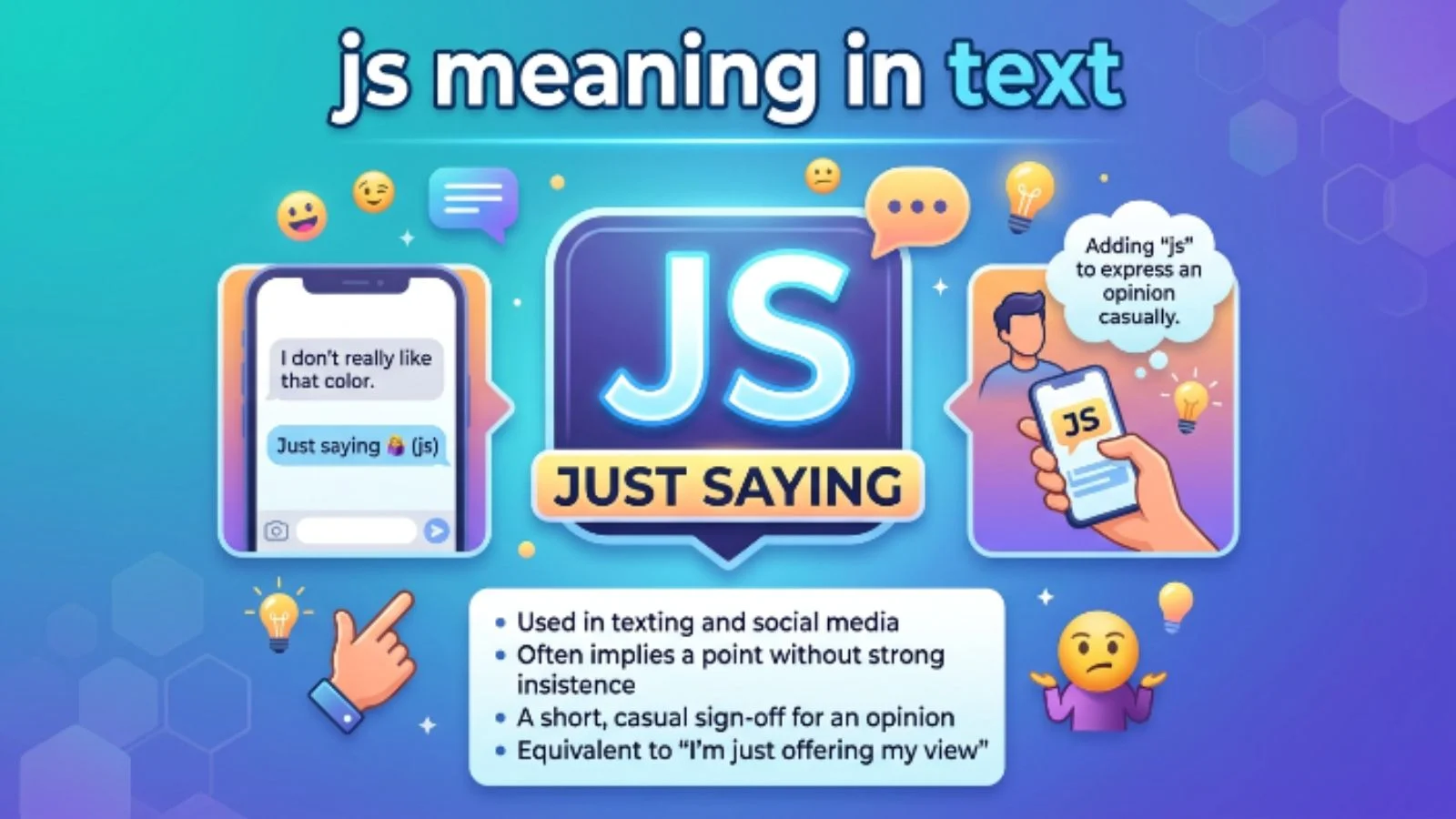
Have you ever received a message that simply said “JS” and wondered what it meant?
You’re not alone.
Text messaging and social media are full of abbreviations, and JS is one of those short terms that can have different meanings depending on the conversation. If you don’t know the context, it can be confusing.
In this guide, you’ll learn exactly what JS means in text, where people use it, why it’s popular, and how to understand it correctly in different situations.
What Does JS Mean in Text?
JS most commonly means “Just Saying.”
People use it when they want to share an opinion, make a comment, or point something out without sounding too serious or argumentative.
Quick Definition
JS = Just Saying
It is often added at the end of a message to emphasize a personal opinion or observation.
Example:
- “You should probably leave earlier next time, JS.”
- “That restaurant was better before they changed the menu, JS.”
In these examples, the sender is expressing a viewpoint without necessarily starting a debate.
Simple Meaning of JS
In simple words, JS means “I’m just sharing my opinion.”
When someone uses JS, they’re often trying to:
- Give advice
- Make an observation
- Express an opinion
- Add a casual comment
- Soften criticism
Think of it as saying:
- “Just my opinion.”
- “That’s what I think.”
- “I’m only saying.”
Example
Text:
“That movie was way too long, JS.”
Meaning:
The person thinks the movie was too long and is casually sharing that opinion.
Where Is JS Used?
JS appears in many online conversations and digital platforms.
Text Messages
Friends often use JS in casual chats.
Example:
- “You could have asked first, JS.”
Social Media
You’ll see it on:
- X
- TikTok
- Threads
Users often add JS when commenting on trends, opinions, or news.
Online Forums
People use JS when discussing topics and sharing viewpoints.
Example:
- “The older version worked better, JS.”
Group Chats
In family or friend group conversations, JS can be used to offer suggestions without sounding overly direct.
Why Do People Use JS?
There are several reasons why this abbreviation became popular.
1. It Saves Time
Typing two letters is faster than writing “just saying.”
2. It Softens Opinions
Sometimes opinions can sound harsh.
Adding JS makes the statement feel more casual.
Example:
Without JS:
- “You spend too much money.”
With JS:
- “You spend too much money, JS.”
The second version often sounds less aggressive.
3. It Adds Personality
People use JS to make conversations feel relaxed and informal.
4. It Helps Avoid Arguments
Many users add JS after a strong opinion to show they’re simply sharing a thought rather than demanding agreement.
Real-Life Examples of JS in Text
Here are some common examples and what they mean.
Example 1
Message:
“You’d probably get better results if you practiced more, JS.”
Meaning:
The sender is giving advice.
Example 2
Message:
“That team should have won the game, JS.”
Meaning:
The sender is sharing an opinion about the match.
Example 3
Message:
“You looked happier at your old job, JS.”
Meaning:
The sender is making an observation.
Example 4
Message:
“Maybe start studying before the night before the test, JS.”
Meaning:
The sender is offering a suggestion.
Example 5
Message:
“The first season was better than the second one, JS.”
Meaning:
A personal opinion is being shared.
Other Meanings of JS
Although Just Saying is the most common texting meaning, JS can sometimes stand for other things.
JavaScript
In technology discussions, JS often means JavaScript, a popular programming language.
Example:
- “I’m learning JS this month.”
Here, JS clearly refers to JavaScript.
Initials
Sometimes JS may represent a person’s initials.
Example:
- “JS called me earlier.”
In this case, it’s referring to someone’s name.
Context Matters
Always look at the surrounding conversation before deciding what JS means.
JS vs Similar Texting Terms
| Term | Meaning | Usage |
|---|---|---|
| JS | Just Saying | Sharing an opinion |
| IMO | In My Opinion | Expressing a viewpoint |
| IMHO | In My Humble Opinion | Giving an opinion politely |
| FYI | For Your Information | Sharing information |
| TBH | To Be Honest | Being honest or direct |
Key Difference
JS is often used at the end of a statement.
IMO and IMHO are usually placed before or within an opinion.
Example:
- “IMO, that was the best option.”
- “That was the best option, JS.”
Both express opinions but in slightly different ways.
When Should You Use JS?
JS works best in casual conversations.
Good Situations
Use JS when:
- Talking with friends
- Sending casual texts
- Commenting on social media
- Sharing observations
- Giving light advice
Examples
- “You might want to back up your files, JS.”
- “That color looks better on you, JS.”
- “Leaving early could help avoid traffic, JS.”
When You Should Avoid JS
There are situations where using JS may not be appropriate.
Professional Emails
In formal communication, write the full message instead of using abbreviations.
Business Settings
Some people may not understand internet slang.
Serious Discussions
JS can sometimes sound passive-aggressive if used during conflicts.
Example:
- “You never listen, JS.”
This may come across as criticism rather than a casual comment.
Common Misunderstandings About JS
Many people misunderstand this abbreviation.
Mistake 1: Thinking It Always Means JavaScript
Not every mention of JS refers to coding.
In everyday texting, “Just Saying” is often the intended meaning.
Mistake 2: Assuming It’s Rude
JS itself is not rude.
However, the sentence before it can determine how it feels.
Example
Friendly:
- “You’d probably enjoy that restaurant, JS.”
Harsh:
- “You always make things difficult, JS.”
The tone changes because of the message, not the abbreviation.
Mistake 3: Using It Too Often
Adding JS to every opinion can become repetitive and annoying.
Use it naturally and only when it adds value.
Pro Tips for Using JS Correctly
Understand the Context
Always consider the conversation before interpreting JS.
Keep It Casual
JS is best suited for informal communication.
Avoid Passive-Aggressive Comments
If your message sounds critical, adding JS may not soften it.
Don’t Overuse It
Using it occasionally makes it more effective.
Consider Your Audience
Not everyone knows texting abbreviations.
If you’re communicating with someone unfamiliar with internet slang, writing “just saying” may be clearer.
Is JS Popular Today?
Yes.
Despite the constant evolution of internet slang, JS remains widely used in texting, social media comments, and online discussions.
Its popularity comes from being:
- Short
- Easy to type
- Easy to understand
- Useful for sharing opinions
Many people use it daily without even thinking about it.
Final Thoughts
So, what does JS mean in text?
In most conversations, JS stands for “Just Saying.” It’s a casual way to share an opinion, suggestion, or observation without sounding overly serious.
The key is understanding the context. While JS can occasionally mean something else, such as JavaScript or a person’s initials, the texting meaning is usually Just Saying.
The next time you see “JS” at the end of a message, you’ll know exactly what the sender is trying to communicate.
Frequently Asked Questions
What does JS mean in texting?
JS usually means “Just Saying.” It is used to express an opinion, observation, or suggestion.
Is JS rude?
No. JS is not inherently rude. However, the overall tone of the message can make it seem friendly or critical.
Does JS always mean Just Saying?
No. In technology discussions, JS often refers to JavaScript. It can also represent someone’s initials.
Can I use JS in professional emails?
It’s generally better to avoid texting abbreviations in formal or professional communication.
Is JS the same as IMO?
Not exactly. Both express opinions, but IMO means “In My Opinion,” while JS means “Just Saying.”
Discover More Post
